Source?prove itsays who?that's just your opinionno cap?I read it somewherefake news[citation needed]link?why should I believe you?citation or it's capsource: vibesdo your own research
peer reviewed?big if truewhere'd you read that?sounds fakeyou got a reference for that?trust me bropics or it didn't happenwho funded that?everyone knows thatan AI told mepress X to doubtI saw a study oncemy uncle said so
SUPPORTED
Taking notes by hand improves recall more than typing.
Paste a claim. trust me bro searches first and judges second. You see the sources it found for and against, and the verdict they add up to.
Checking a quote? Compare it with the original source and read the context around it. Citing a paper? We look up its recorded DOI for retractions.
The citation comes formatted and ready to paste. Everything lands on a public receipt you can share. Think it's wrong? Sign in and submit a counter-source for review.
Fact-checking organizations cannot keep pace with the volume of claims published online
the verdict
SUPPORTED
the evidence backs this
Recorded sources
3 sources for · 0 against
Counts group repeated records of the same source within each side. They do not measure evidence strength or source independence.
Is it true that fact-checking organizations cannot keep pace with the volume of claims published online?
Yes. Evidence consistently shows that traditional, manual fact-checking organizations struggle and ultimately fail to keep pace with the sheer volume of claims published online, motivating the development of automated computational tools.
Verdict: SUPPORTED · 3 sources for, 0 against · Last checked
The analysis
The claim that fact-checking organizations cannot keep pace with the volume of online claims is widely supported in the literature, notably by older foundational work (e.g., Ciampaglia et al., 2015) as well as recent automated fact-checking studies (e.g., Hu et al., 2026; Chen et al., 2025) emphasizing the need for AI solutions due to human scalability limits. There are no papers refuting this widely acknowledged constraint.
Human moderators face significant challenges regarding scalability when attempting to keep pace with the volume of online misinformation.
Get citation
DN, W., C, M., L, Z., C, P., & R, M. (2026). Performance of Large Language Models in the Cognitive Analysis of Misinformation: Evaluation Study.. doi.org. https://doi.org/10.2196/72524 Retrieved July 28, 2026.
Traditional manual fact-checking approaches are resource-intensive and unable to match the pace at which misinformation spreads online.
Get citation
S, E., J, M., S, B., & A, G. (2025). Development and validation of a multi-agent AI pipeline for automated credibility assessment of tobacco misinformation: a proof-of-concept study.. doi.org. https://doi.org/10.3389/frai.2025.1659861 Retrieved July 28, 2026.
Traditional fact-checking by expert journalists cannot keep up with the enormous volume of information generated online.
Get citation
Ciampaglia, G. L., Shiralkar, P., Rocha, L. M., Bollen, J., Menczer, F., & Flammini, A. (2015). Computational Fact Checking from Knowledge Networks. doi.org. https://doi.org/10.1371/journal.pone.0128193 Retrieved July 28, 2026.
What does the evidence say?
The claim that fact-checking organizations cannot keep pace with the volume of online claims is widely supported in the literature, notably by older foundational work (e.g., Ciampaglia et al., 2015) as well as recent automated fact-checking studies (e.g., Hu et al., 2026; Chen et al., 2025) emphasizing the need for AI solutions due to human scalability limits. There are no papers refuting this widely acknowledged constraint.
Receipt History
first checked28 Jul 2026
judged → SUPPORTED · 7528 Jul 2026
Anyone with this link can read the claim and its public receipt, including any
personal information in that text. Open permanent receipt.
One for the claim, one for the argument. Both point at recorded evidence.
A citation
A real paper: authors, year, DOI, in your format.
Cepeda, N. J., Pashler, H., Vul, E., Wixted, J. T., & Rohrer, D. (2006).
Distributed practice in verbal recall tasks: A review and quantitative synthesis.
Psychological Bulletin, 132(3), 354–380.
For source citations
A receipt
The claim, the verdict, both sides, on a shareable link.
For arguments
Inspect the sources.
A citation identifies a source; it does not establish that the source supports
your claim. Check the source text, context and the receipt's recorded limitations.
22,061 receipts minted.
Everything between "source?" and "oh!"
Citations & receiptsCheck a claim and inspect the sources returned for it. Coverage is limited; a citation is not guaranteed for every claim.
Read the recorded outcomeInspect the verdict, evidence and limitations, including partial or unavailable outcomes.
Inspect the excerptsCheck quotations against the original source and read their context.
Retraction informationScans look up recorded DOIs in OpenAlex. They do not cover every source or guarantee an overnight update.
Highlight a claimOn supported pages, select text and use right-click or your configured shortcut. Bro and Pro can enable the optional selection button after accepting the disclosure and browser page access. Selecting text alone sends no claim.
Challenge a receiptSign in to submit a counter-source for manual review. Submission does not automatically re-run the engine.
Henry Ford stated that if he had asked customers what they wanted they would have said faster horses
the verdict
REFUTED
the evidence says no
Recorded sources
0 sources for · 1 against
Counts group repeated records of the same source within each side. They do not measure evidence strength or source independence.
Is it true that Henry Ford stated that if he had asked customers what they wanted they would have said faster horses?
No. Wikiquote lists this among quotations MISATTRIBUTED to Henry Ford — the words are widely repeated as theirs, and the archive records that they are not. Patrick Vlaskovits, "Henry Ford, Innovation, and That "Faster Horse" Quote," in "Harvard Business Review" (August 29, 2011).
Verdict: REFUTED · 0 sources for, 1 against · Last checked
The analysis
Judged against the evidence record for claims of this kind.
Iorio, L. (n.d.). Naming the Universe. play.google.com. https://play.google.com/store/books/details?id=8qevEQAAQBAJ&source=gbs_api Retrieved September 12, 2026.
White, C. (n.d.). Organometallic Compounds of Cobalt, Rhodium, and Iridium. books.google.com. http://books.google.com/books?id=GwXwAAAAMAAJ&dq=Rhodium+has+atomic+number+45.&hl=&as_pt=BOOKS&source=gbs_api Retrieved September 12, 2026.
Counts group repeated records of the same source within each side. They do not measure evidence strength or source independence.
Is it true that Goldfish have a memory span of only three seconds?
No. Scientific consensus and fact-checking sources debunk the idea that goldfish only have a three-second memory, proving their memory spans last for months.
Verdict: REFUTED · 0 sources for, 4 against · Last checked
How claims like this are judged
Judged on the fact-checker and reference record: claims of this kind are settled by fact-checkers and reference works, not journal abstracts.
Wikipedia: List of common misconceptions about science, technology, and mathematics. (n.d.). en.wikipedia.org. https://en.wikipedia.org/wiki/List_of_common_misconceptions_about_science,_technology,_and_mathematics Retrieved July 28, 2026.
Book: QI: The Pocket Book of General Ignorance. (2008). books.google.com. http://books.google.com/books?id=V7kMttNBLyIC&dq=Goldfish+have+a+memory+span+of+only+three+seconds&hl=&as_pt=BOOKS&source=gbs_api Retrieved July 28, 2026.
Book: The Book of General Ignorance. (2007). books.google.com. http://books.google.com/books?id=AS8qAAAAYAAJ&dq=Goldfish+have+a+memory+span+of+only+three+seconds&hl=&as_pt=BOOKS&source=gbs_api Retrieved July 28, 2026.
Receipt History
Anyone with this link can read the claim and its public receipt, including any
personal information in that text. Open permanent receipt.
The Great Wall of China is visible from space with the naked eye
the verdict
REFUTED
the evidence says no
Recorded sources
0 sources for · 3 against
Counts group repeated records of the same source within each side. They do not measure evidence strength or source independence.
Is it true that the Great Wall of China is visible from space with the naked eye?
No. The claim that the Great Wall of China is visible from space with the naked eye is a widespread myth. Scientific sources and fact-checkers confirm that the wall cannot be readily distinguished from space without magnification.
Verdict: REFUTED · 0 sources for, 3 against · Last checked
How claims like this are judged
Judged on the fact-checker and reference record: claims of this kind are settled by fact-checkers and reference works, not journal abstracts.
Snopes: Is the Great Wall of China Visible from the Moon?. (n.d.). snopes.com. https://www.snopes.com/fact-check/great-wall-from-moon/ Retrieved July 28, 2026.
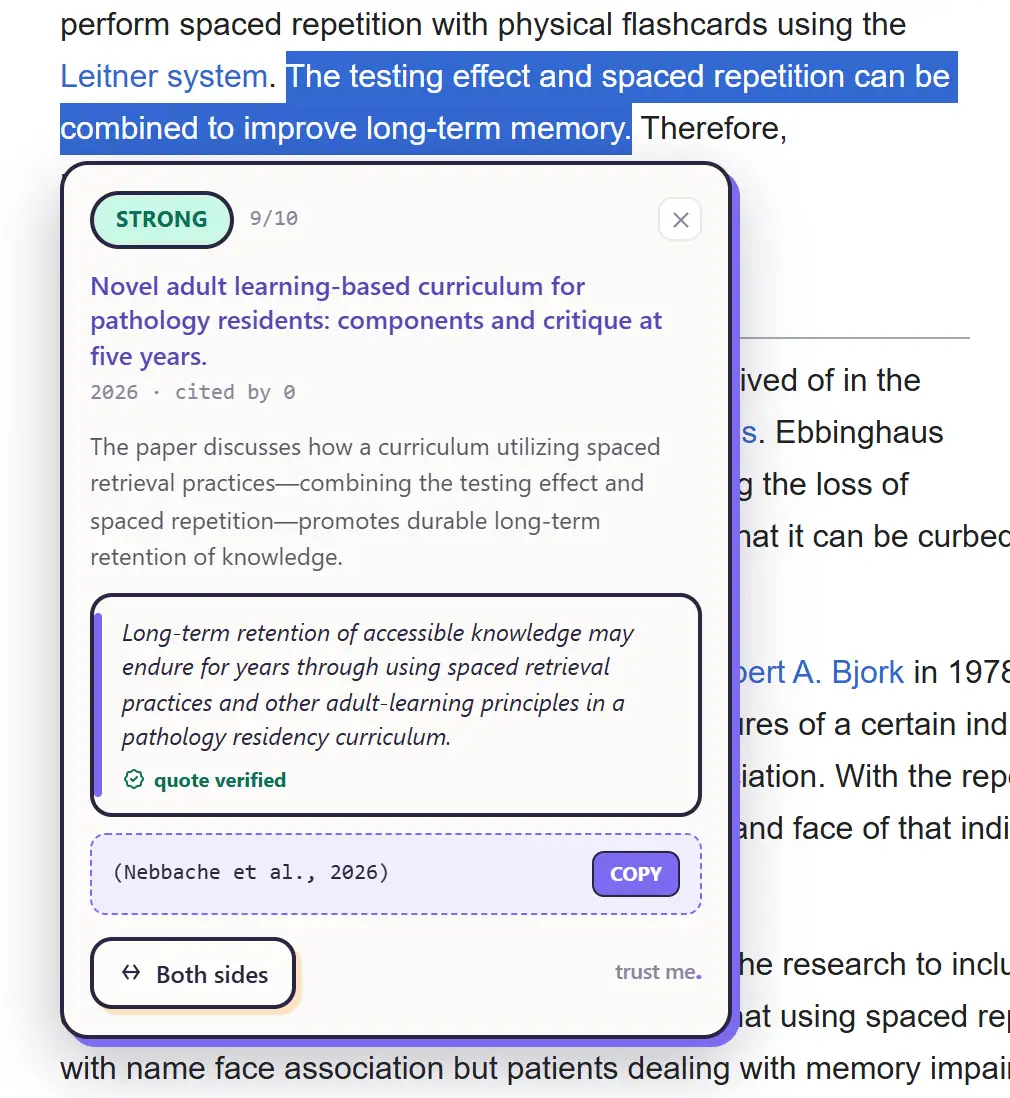
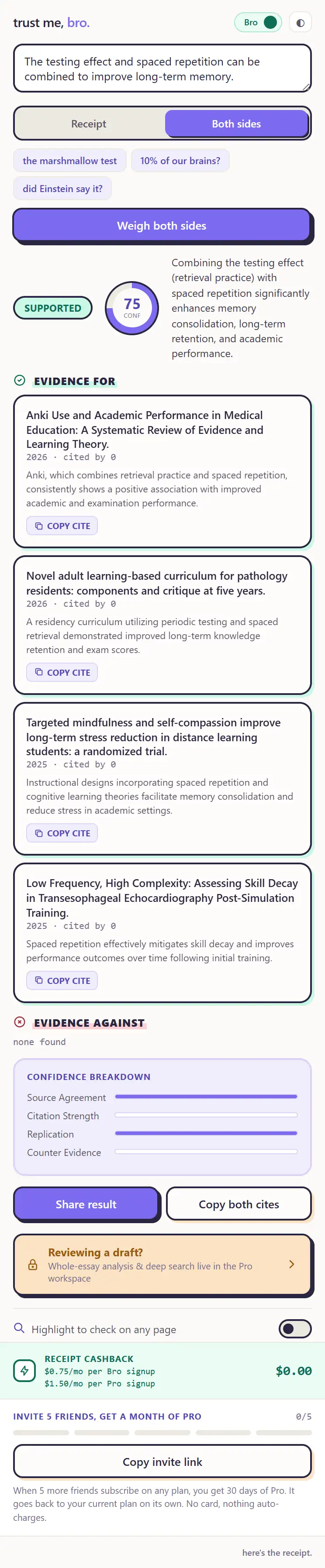
Earlier interface preview: in-page results. Deliberate right-click and shortcut checks use supported pages. Bro and Pro can enable the optional selection button after accepting the disclosure and browser page access. Selecting text alone sends no claim.Earlier interface preview: the popup. Inspect recorded evidence for and against a claim, with citation controls for available sources.
Other tools do some things. Only trust me bro does it all.
Feature
trust me.
GPTZero
Consensus
Zotero
Grammarly
Jenni
Retrieves potential evidence sources
✓
·
✓
·
·
·
Judges whether it supports the claim
✓
·
·
·
·
·
Shows the evidence against, too
✓
·
·
·
·
·
Verifies quotes word for word
✓
·
·
·
·
·
Catches retracted papers
✓
·
·
·
·
·
Formats the citation
✓
·
✓
✓
·
✓
Works on the page you are reading
✓
✓
·
·
✓
·
Hands you a shareable receipt
✓
·
·
·
·
·
Anyone can challenge the verdict
✓
·
·
·
·
·
Price
$9.99/mo
$15/mo
$8.99/mo
free
$12/mo
$20/mo
Competitor prices are their advertised individual plans, checked
July 2026. We are not affiliated with any of them.
Taste it
Free
$0/mo
10 checks a month, no card. Receipts and share links included. Signed-in API is $0.10 per seat.
MOST POPULAR
Win the argument
Bro
$9.99/mo
$99/yr · $8.25/mo, billed annually
12 months for the price of 10. Two months free.
400 claim checks and 100 API calls a month, the highlight pill, and every citation format.
MOST POWERFUL
Build with receipts
Pro
$29.99/mo
$299/yr · $24.92/mo, billed annually
12 months for the price of 10. Two months free.
1,000 claim checks and 1,000 API calls a month, plus the saved claim library.
For a group
Team / Enterprise
Consult · quarterly
Arranged by consultation and billed quarterly. Not sold through checkout. See pricing.
Coming soon Invite five friends, get a month of Pro.
When five people you
invite subscribe to any paid plan, we hand you thirty days of Pro. It ends by itself
and goes back to the plan you were on. No card, nothing to cancel.
Before you ask: fair questions.
What's the difference between a citation and a receipt?
A citation identifies a source using available bibliographic details. A receipt presents a recorded claim outcome, evidence and limitations. It does not guarantee a settled answer, a confidence score or support from every cited source.
Who is this actually for?
Someone mid-argument who knows they read it somewhere and needs the source in ten seconds. Paste a claim in the popup or use a deliberate page selection.
What does it work on?
Paste a claim in the extension popup, or deliberately check a selection on supported pages using right-click or your configured shortcut. Direct editing in Google Docs and other rich-text editors is not universally supported; use paste.
Can I use this inside my own product?
The Trust API accepts one claim per request and returns recorded result fields and available sources. Confidence may be unavailable, and checks may produce public receipts. Do not submit confidential or personal information. Read the API page for authentication, limits, current prices and response handling.
Is it free?
Ten checks a month are free, receipts and share links included, no card. A signed-in Free account is one API seat at $0.10. That is the seat price, not a charge per call. Bro is $9.99 a month for 400 checks and 100 API calls; Pro is $29.99 for 1,000 of each. Annual is twelve months for the price of ten. Team and Enterprise plans are arranged by consultation and billed quarterly.
The Great Wall of China is visible from space with the naked eye
the verdict
REFUTED
the evidence says no
Recorded sources
0 sources for · 3 against
Counts group repeated records of the same source within each side. They do not measure evidence strength or source independence.
Is it true that the Great Wall of China is visible from space with the naked eye?
No. The claim that the Great Wall of China is visible from space with the naked eye is a widespread myth. Scientific sources and fact-checkers confirm that the wall cannot be readily distinguished from space without magnification.
Verdict: REFUTED · 0 sources for, 3 against · Last checked
How claims like this are judged
Judged on the fact-checker and reference record: claims of this kind are settled by fact-checkers and reference works, not journal abstracts.
Snopes: Is the Great Wall of China Visible from the Moon?. (n.d.). snopes.com. https://www.snopes.com/fact-check/great-wall-from-moon/ Retrieved July 28, 2026.
Counts group repeated records of the same source within each side. They do not measure evidence strength or source independence.
Is it true that Goldfish have a memory span of only three seconds?
No. Scientific consensus and fact-checking sources debunk the idea that goldfish only have a three-second memory, proving their memory spans last for months.
Verdict: REFUTED · 0 sources for, 4 against · Last checked
How claims like this are judged
Judged on the fact-checker and reference record: claims of this kind are settled by fact-checkers and reference works, not journal abstracts.
Wikipedia: List of common misconceptions about science, technology, and mathematics. (n.d.). en.wikipedia.org. https://en.wikipedia.org/wiki/List_of_common_misconceptions_about_science,_technology,_and_mathematics Retrieved July 28, 2026.
Book: QI: The Pocket Book of General Ignorance. (2008). books.google.com. http://books.google.com/books?id=V7kMttNBLyIC&dq=Goldfish+have+a+memory+span+of+only+three+seconds&hl=&as_pt=BOOKS&source=gbs_api Retrieved July 28, 2026.
Book: The Book of General Ignorance. (2007). books.google.com. http://books.google.com/books?id=AS8qAAAAYAAJ&dq=Goldfish+have+a+memory+span+of+only+three+seconds&hl=&as_pt=BOOKS&source=gbs_api Retrieved July 28, 2026.
Receipt History
Anyone with this link can read the claim and its public receipt, including any
personal information in that text. Open permanent receipt.
Iorio, L. (n.d.). Naming the Universe. play.google.com. https://play.google.com/store/books/details?id=8qevEQAAQBAJ&source=gbs_api Retrieved September 12, 2026.
White, C. (n.d.). Organometallic Compounds of Cobalt, Rhodium, and Iridium. books.google.com. http://books.google.com/books?id=GwXwAAAAMAAJ&dq=Rhodium+has+atomic+number+45.&hl=&as_pt=BOOKS&source=gbs_api Retrieved September 12, 2026.
Fact-checking organizations cannot keep pace with the volume of claims published online
the verdict
SUPPORTED
the evidence backs this
Recorded sources
3 sources for · 0 against
Counts group repeated records of the same source within each side. They do not measure evidence strength or source independence.
Is it true that fact-checking organizations cannot keep pace with the volume of claims published online?
Yes. Evidence consistently shows that traditional, manual fact-checking organizations struggle and ultimately fail to keep pace with the sheer volume of claims published online, motivating the development of automated computational tools.
Verdict: SUPPORTED · 3 sources for, 0 against · Last checked
The analysis
The claim that fact-checking organizations cannot keep pace with the volume of online claims is widely supported in the literature, notably by older foundational work (e.g., Ciampaglia et al., 2015) as well as recent automated fact-checking studies (e.g., Hu et al., 2026; Chen et al., 2025) emphasizing the need for AI solutions due to human scalability limits. There are no papers refuting this widely acknowledged constraint.
Human moderators face significant challenges regarding scalability when attempting to keep pace with the volume of online misinformation.
Get citation
DN, W., C, M., L, Z., C, P., & R, M. (2026). Performance of Large Language Models in the Cognitive Analysis of Misinformation: Evaluation Study.. doi.org. https://doi.org/10.2196/72524 Retrieved July 28, 2026.
Traditional manual fact-checking approaches are resource-intensive and unable to match the pace at which misinformation spreads online.
Get citation
S, E., J, M., S, B., & A, G. (2025). Development and validation of a multi-agent AI pipeline for automated credibility assessment of tobacco misinformation: a proof-of-concept study.. doi.org. https://doi.org/10.3389/frai.2025.1659861 Retrieved July 28, 2026.
Traditional fact-checking by expert journalists cannot keep up with the enormous volume of information generated online.
Get citation
Ciampaglia, G. L., Shiralkar, P., Rocha, L. M., Bollen, J., Menczer, F., & Flammini, A. (2015). Computational Fact Checking from Knowledge Networks. doi.org. https://doi.org/10.1371/journal.pone.0128193 Retrieved July 28, 2026.
What does the evidence say?
The claim that fact-checking organizations cannot keep pace with the volume of online claims is widely supported in the literature, notably by older foundational work (e.g., Ciampaglia et al., 2015) as well as recent automated fact-checking studies (e.g., Hu et al., 2026; Chen et al., 2025) emphasizing the need for AI solutions due to human scalability limits. There are no papers refuting this widely acknowledged constraint.
Receipt History
first checked28 Jul 2026
judged → SUPPORTED · 7528 Jul 2026
Anyone with this link can read the claim and its public receipt, including any
personal information in that text. Open permanent receipt.