trust me, bro.
Paste any claim and get:
- Real citations
- A verdict
- A public receipt you can share
Full fact checking, finally.
The problem: the internet runs on unproven claims.
Most of what you read is asserted, not sourced. AI made it faster to assert and no easier to check.
We checked our own claimFact-checking organizations cannot keep pace with the volume of claims published online
Is it true that fact-checking organizations cannot keep pace with the volume of claims published online?
Yes. Evidence consistently shows that traditional, manual fact-checking organizations struggle and ultimately fail to keep pace with the sheer volume of claims published online, motivating the development of automated computational tools.
Verdict: SUPPORTED · 3 sources for, 0 against · Last checked
The claim that fact-checking organizations cannot keep pace with the volume of online claims is widely supported in the literature, notably by older foundational work (e.g., Ciampaglia et al., 2015) as well as recent automated fact-checking studies (e.g., Hu et al., 2026; Chen et al., 2025) emphasizing the need for AI solutions due to human scalability limits. There are no papers refuting this widely acknowledged constraint.
Get citation
DN, W., C, M., L, Z., C, P., & R, M. (2026). Performance of Large Language Models in the Cognitive Analysis of Misinformation: Evaluation Study.. doi.org. https://doi.org/10.2196/72524
See more details
Get citation
S, E., J, M., S, B., & A, G. (2025). Development and validation of a multi-agent AI pipeline for automated credibility assessment of tobacco misinformation: a proof-of-concept study.. doi.org. https://doi.org/10.3389/frai.2025.1659861
Get citation
Ciampaglia, G. L., Shiralkar, P., Rocha, L. M., Bollen, J., Menczer, F., & Flammini, A. (2015). Computational Fact Checking from Knowledge Networks. doi.org. https://doi.org/10.1371/journal.pone.0128193
What does the evidence say?
The claim that fact-checking organizations cannot keep pace with the volume of online claims is widely supported in the literature, notably by older foundational work (e.g., Ciampaglia et al., 2015) as well as recent automated fact-checking studies (e.g., Hu et al., 2026; Chen et al., 2025) emphasizing the need for AI solutions due to human scalability limits. There are no papers refuting this widely acknowledged constraint.
Challenge the receipt
Trust, the solution: two shapes.
One for the claim, one for the argument. Both point at recorded evidence.
Everything between "source?" and "oh!"
The receipts. Here's what that actually looks like:
The Great Wall of China is visible from space with the naked eye
Is it true that the Great Wall of China is visible from space with the naked eye?
No. The claim that the Great Wall of China is visible from space with the naked eye is a widespread myth. Scientific sources and fact-checkers confirm that the wall cannot be readily distinguished from space without magnification.
Verdict: REFUTED · 0 sources for, 3 against · Last checked
Judged on the fact-checker and reference record: claims of this kind are settled by fact-checkers and reference works, not journal abstracts.
Get citation
Snopes: Is the Great Wall of China Visible from the Moon?. (n.d.). snopes.com. https://www.snopes.com/fact-check/great-wall-from-moon/
See more details
Get citation
Wikipedia: Artificial structures visible from space. (n.d.). en.wikipedia.org. https://en.wikipedia.org/wiki/Artificial_structures_visible_from_space
Get citation
Wikipedia: Great Wall of China. (n.d.). en.wikipedia.org. https://en.wikipedia.org/wiki/Great_Wall_of_China
Challenge the receipt
Rhodium has atomic number 45.
Is it true that Rhodium has atomic number 45?
Yes. Multiple independent reference sources and database entries confirm that rhodium is a chemical element with atomic number 45.
Verdict: SUPPORTED · 4 sources for, 0 against · Last checked
Get citation
Rhodium. (n.d.). en.wikipedia.org. https://en.wikipedia.org/wiki/Rhodium
2 recorded entries grouped as this source
Get citation
Rhodium - Wikipedia. (n.d.). en.wikipedia.org. https://en.wikipedia.org/wiki/Rhodium
See more details
Get citation
Iorio, L. (2026). Naming the Universe. play.google.com. https://play.google.com/store/books/details?id=8qevEQAAQBAJ&source=gbs_api
Get citation
White, C. (1985). Organometallic Compounds of Cobalt, Rhodium, and Iridium. books.google.com. http://books.google.com/books?id=GwXwAAAAMAAJ&dq=Rhodium+has+atomic+number+45.&hl=&as_pt=BOOKS&source=gbs_api
Get citation
ロジウム・アレルギーによる職業性皮膚症について. (n.d.). cir.nii.ac.jp. https://cir.nii.ac.jp/crid/1390001204799818240
Challenge the receipt
Goldfish have a memory span of only three seconds
Is it true that Goldfish have a memory span of only three seconds?
No. Scientific consensus and fact-checking sources debunk the idea that goldfish only have a three-second memory, proving their memory spans last for months.
Verdict: REFUTED · 0 sources for, 4 against · Last checked
Judged on the fact-checker and reference record: claims of this kind are settled by fact-checkers and reference works, not journal abstracts.
Get citation
Wikipedia: Goldfish. (n.d.). en.wikipedia.org. https://en.wikipedia.org/wiki/Goldfish
See more details
Get citation
Wikipedia: List of common misconceptions about science, technology, and mathematics. (n.d.). en.wikipedia.org. https://en.wikipedia.org/wiki/List_of_common_misconceptions_about_science,_technology,_and_mathematics
Get citation
Book: QI: The Pocket Book of General Ignorance. (2008). books.google.com. http://books.google.com/books?id=V7kMttNBLyIC&dq=Goldfish+have+a+memory+span+of+only+three+seconds&hl=&as_pt=BOOKS&source=gbs_api
Get citation
Book: The Book of General Ignorance. (2007). books.google.com. http://books.google.com/books?id=AS8qAAAAYAAJ&dq=Goldfish+have+a+memory+span+of+only+three+seconds&hl=&as_pt=BOOKS&source=gbs_api
Challenge the receipt
Henry Ford stated that if he had asked customers what they wanted they would have said faster horses
Is it true that Henry Ford stated that if he had asked customers what they wanted they would have said faster horses?
No. Wikiquote lists this among quotations MISATTRIBUTED to Henry Ford — the words are widely repeated as theirs, and the archive records that they are not. Patrick Vlaskovits, "Henry Ford, Innovation, and That "Faster Horse" Quote," in "Harvard Business Review" (August 29, 2011).
Verdict: REFUTED · 0 sources for, 1 against · Last checked
Judged against the evidence record for claims of this kind.
Get citation
Wikiquote: Henry Ford. (n.d.). Wikiquote. https://en.wikiquote.org/wiki/Henry_Ford
What does the evidence say?
Judged against the evidence record for claims of this kind.
Challenge the receipt
The extension lives where the arguments live.
The popup checks a claim. The Receipts tab keeps your history and searches the Trust Wiki. Add it from the Chrome Web Store. See how it works →
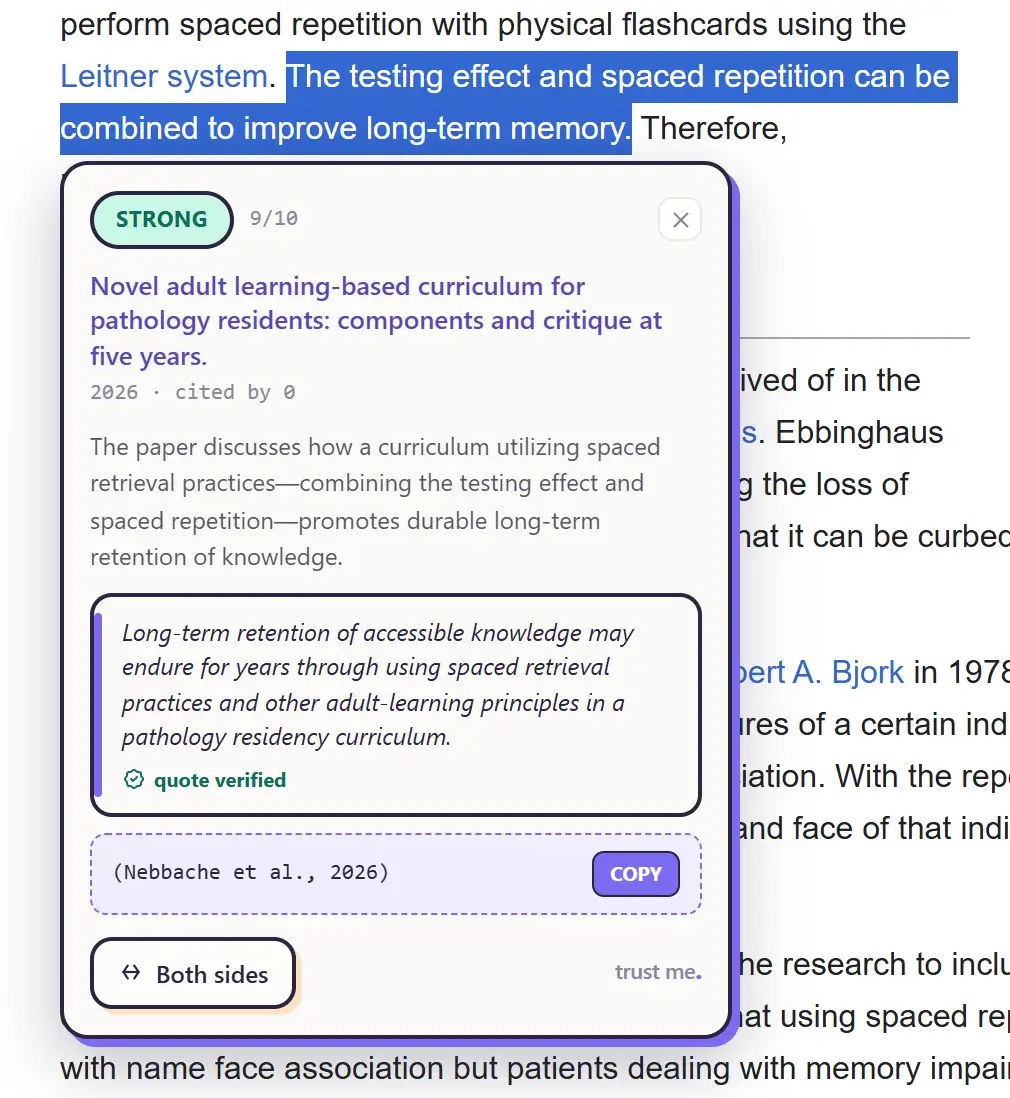
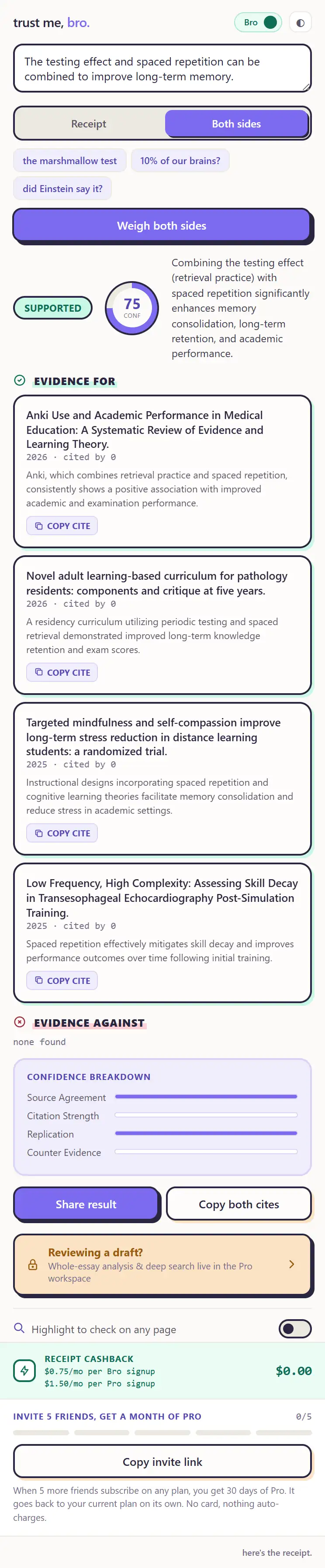
Other tools do some things. Only trust me bro does it all.
| Feature | trust me. | GPTZero | Consensus | Zotero | Grammarly | Jenni |
|---|---|---|---|---|---|---|
| Retrieves potential evidence sources | ✓ | · | ✓ | · | · | · |
| Judges whether it supports the claim | ✓ | · | · | · | · | · |
| Shows the evidence against, too | ✓ | · | · | · | · | · |
| Verifies quotes word for word | ✓ | · | · | · | · | · |
| Catches retracted papers | ✓ | · | · | · | · | · |
| Formats the citation | ✓ | · | ✓ | ✓ | · | ✓ |
| Works on the page you are reading | ✓ | ✓ | · | · | ✓ | · |
| Hands you a shareable receipt | ✓ | · | · | · | · | · |
| Anyone can challenge the verdict | ✓ | · | · | · | · | · |
| Price | $9.99/mo | $15/mo | $8.99/mo | free | $12/mo | $20/mo |
Competitor prices are their advertised individual plans, checked July 2026. We are not affiliated with any of them.
Invite five friends, get a month of Pro.
Before you ask: fair questions.
What's the difference between a citation and a receipt?
A citation identifies a source using available bibliographic details. A receipt presents a recorded claim outcome, evidence and limitations. It does not guarantee a settled answer, a confidence score or support from every cited source.
Who is this actually for?
Someone mid-argument who knows they read it somewhere and needs the source in ten seconds. Paste a claim in the popup or use a deliberate page selection.
What does it work on?
Paste a claim in the extension popup, or deliberately check a selection on supported pages using right-click or your configured shortcut. Direct editing in Google Docs and other rich-text editors is not universally supported; use paste.
Can I use this inside my own product?
The Trust API accepts one claim per request and returns recorded result fields and available sources. Confidence may be unavailable, and checks may produce public receipts. Do not submit confidential or personal information. Read the API page for authentication, limits, current prices and response handling.
Is it free?
Five checks a month are free, receipts and share links included, no card. Bro is $9.99 a month for 400 checks and 100 API calls; Pro is $29.99 for 1,000 of each. Annual is twelve months for the price of ten.
Don't take our word for it. That's the whole point.
Already on the record: 10 percent of our brains · the marshmallow test · power posing · the Great Wall from space
Citation formatting by citeproc-js (Frank Bennett) and the Citation Style Language project. Source and licenses.