Pitch and yaw control axes direct the aerodynamic and orbital orientation of launch vehicles
the verdict
SUPPORTED
the evidence backs this
refutedsupported
the weight of evidence
6 sources for · 0 against
Reference and peer-reviewed aerospace literature establishes that pitch and yaw control axes direct the aerodynamic and orbital orientation of space vehicles and launch systems.
This is a 25-pound thrust Gemini Orbital Attitude Maneuvering System (OAMS) thruster. OAMS thrusters performed four functions: (1) provided the necessary thrust for the Gemini spacecraft to rendezvous with the Agena target vehicle; (2) controlled the spacecraft in orbit; (3), enabled the separation of the Gemini from the second stage Titan launch vehicle and inserted it into orbit; and (4), provided abort capability. For these functions, the OAMS included 25-pound thrust thrusters to control the spacecraft in its pitch, yaw, and roll axes. OAMS thrusters used hypergolic (self-igniting) propell
relative to three mutually perpendicular axes of rotation, referred to as roll, pitch, and yaw. Orientation can be determined by calibration using an
Spacecraft flight dynamics is the application of mechanical dynamics to model how the external forces acting on a space vehicle or spacecraft determine its flight path. These forces are primarily of three types: propulsive force provided by the vehicle's engines; gravitational force exerted by the Earth and other celestial bodies; and aerodynamic lift and drag (when flying in the atmosphere of the
Spacecraft flight dynamics is the application of mechanical dynamics to model how the external forces acting on a space vehicle or spacecraft determine its flight path. These forces are primarily of three types: propulsive force provided by the vehicle's engines; gravitational force exerted by the Earth and other celestial bodies; and aerodynamic lift and drag (when flying in the atmosphere of the Earth or other body, such as Mars or Venus).
The principles of flight dynamics are used to model a vehicle's powered flight during launch from the Earth; a spacecraft's orbital flight; maneuvers to change orbit; translunar and interplanetary flight; launch from and landing on a celestial body, with or without an atmosphere; entry through the atmosphere of the Earth or other celestial body; and attitude control. They are generally programmed into a vehicle's inertial navigation systems, and monitored on the ground by a member of the flight controller team known in NASA as the flight dynamics officer, or in the European Space Agency as the spacecraft navigator.
Flight dynamics depends on the disciplines of propulsion, aerodynamics, and astrodynamics (orbital mechanics and celestial mechanics). It cannot be reduced to simply attitude control; real spacecraft do not have steering wheels or tillers like airplanes or ships. Unlike the way fictional spaceships are portrayed, a spacecraft actually does not bank to turn in outer space, where its…
Si…
The three principal moments of inertia Ix, Iy, and Iz about the roll, pitch and yaw axes, are determined through the vehicle's center of mass.
The control torque for a launch vehicle is sometimes provided aerodynamically by movable fins, and usually by mounting the engines on gimbals to vector the thrust around the center of mass. Torque is frequently applied to spacecraft, operating absent aerodynamic forces, by a reaction control system, a set of thrusters located about the vehicle. The thrusters are fired, either manually or under automatic guidance control, in short bursts to achieve the desired rate of rotation, and then fired in the opposite direction to halt rotation at the desired position. The torque about a specific axis is:
This is a 100-pound thrust Gemini Orbital Attitude Maneuvering System (OAMS) thruster. OAMS thrusters: (1) provided thrust for the Gemini spacecraft to rendezvous with the Agena target vehicle; (2) controlled the spacecraft in orbit; (3) enabled separation of the Gemini from the second stage Titan launch vehicle and inserted it into orbit; and (4) provided abort capability. The OAMS consisted of 100-pound thrusters to maneuver the craft axially, vertically, and laterally; 85-pound motors for forward and rearward motions; and 25-pound motors to control the spacecraft in its pitch, yaw, and roll
This paper proposes new Bank-to-Steer (BTS) control algorithms for controlling the attitude of an Apollo style capsule during guided re-entry phase. The fundamental design challenge is dynamic coupling between roll and yaw axes as a function of trim Angle-ofAttack (or pitch angle) which varies widely during the guided re-entry phase. To solve this problem, two novel approaches are proposed. The trim AOA is estimated in real-time using only the polarity of the commanded torque generated by the BTS control algorithms, without using air data from direct measurement systems as in Space Shuttle or estimation using onboard sensors and stored knowledge about flight mechanics as in Kistler. The coupled roll and yaw axes are controlled by an MIMO gain-scheduled state-feedback control algorithm. This algorithm is based on mature linear parameter varying (LPV) synthesis and proven pulse-width-pulse-frequency (PWPF) modulator. These algorithms have potential advantages over Apollo and Kistler BTS control algorithms: estimation of trim AOA is relatively simple and effective even in the presence of off-nominal flight conditions; the BTS control algorithm does not need the table of optimal gain sets and associated time-consuming procedure of gain design at different trim conditions because it automatically tunes the nominal gains as a function of trim AOA; the BTS control algorithm is so flexible that it can be re-used for other phases such as skip re-entry phase and attitude-to-velocity ph
In this paper, an advanced flight simulation model of the ILR-33 AMBER rocket is shown. The model is designed for Hardware-in-the-Loop (HiL) tests of the rocket control system. It permits us to simulate flight dynamics in a 6DOF environment, with consideration of the variable thrust, mass-inertia, and aerodynamics. It reproduces key functionalities of on-board computer and sensors and allows us to reproduce multiple mission scenarios. Simplifying assumptions concerning the environment and coordinate systems were made, reducing calculation costs while preserving key functionalities of the simulation. The control system consists of four movable canards, actuators, and motion controllers. The process of integration between the simulation model and hardware using a real-time computer is shown. Efficient communication between those elements was developed and tested in simulated flight conditions. In the final part, relevant control system HiL tests were presented. An extensive comparison between unguided and guided flight trajectories was performed. The impact of the control system operation on all analyzed parameters is clearly demonstrated. The results confirmed the usefulness of the simulation model for the task it was developed for. The potential of the HiL method in the design of complex control systems for suborbital rockets is proven.
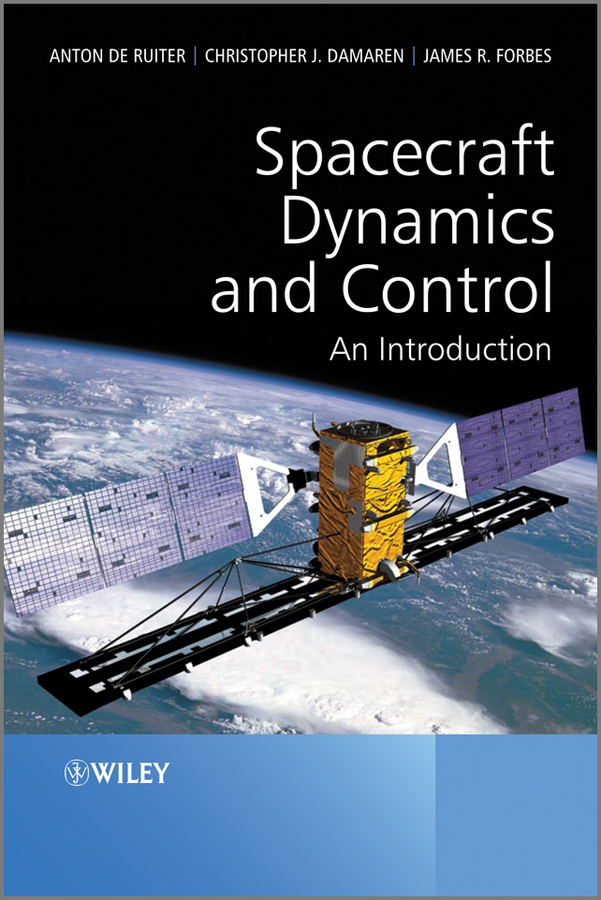
"Provides the basics of spacecraft orbital dynamics plus attitude dynamics and control, using vectrix notationSpacecraft Dynamics and Control: An Introduction presents the fundamentals of classical control in the context of spacecraft attitude control. This approach is particularly beneficial for the training of students in both of the subjects of classical control as well as its application to spacecraft attitude control. By using a physical system (a spacecraft) that the reader can visualize (rather than arbitrary transfer functions), it is easier to grasp the motivation for why topics in co
Everything we examined (6) — 5 independent sources
This check searched the claim as stated. It did not run a separate search for evidence against it.